When you work for yourself, you are the business. You're also the sick leave policy, the HR department and the person who keeps the bills paid when something goes wrong.
Plenty of self-employed women have thought about what would happen if they couldn't work for a few months. Far fewer have a plan for it.
Income protection is that plan. It pays you a monthly amount if illness or injury stops you working, so the mortgage, the groceries and the business costs keep getting covered while you recover. Here's how it works in New Zealand, where the gaps are, and what changes if you're planning a family.
Doesn't ACC cover me?
For accidents, yes. For illness, no.
If you're injured in an accident, ACC can pay weekly compensation of up to 80% of your earnings while you recover (capped at a maximum amount). For self-employed people, that figure is based on the income you've declared, which can be lower than you expect if your earnings vary or you've just started out.
Illness is a different story. Cancer, a heart condition, a complicated pregnancy, a long recovery from surgery or a serious mental health condition all sit outside ACC. If one of those keeps you off work, ACC won't pay. And with no employer, there's no sick leave to fall back on.
That's the gap income protection is designed to fill. Most policies cover both illness and injury, and many can work alongside ACC so you're not left short.
Indemnity vs agreed value: the choice that matters most
Income protection usually pays a portion of your income, often up to around 75%. How that income is measured depends on the type of policy, and for self-employed women this is the detail worth slowing down on.
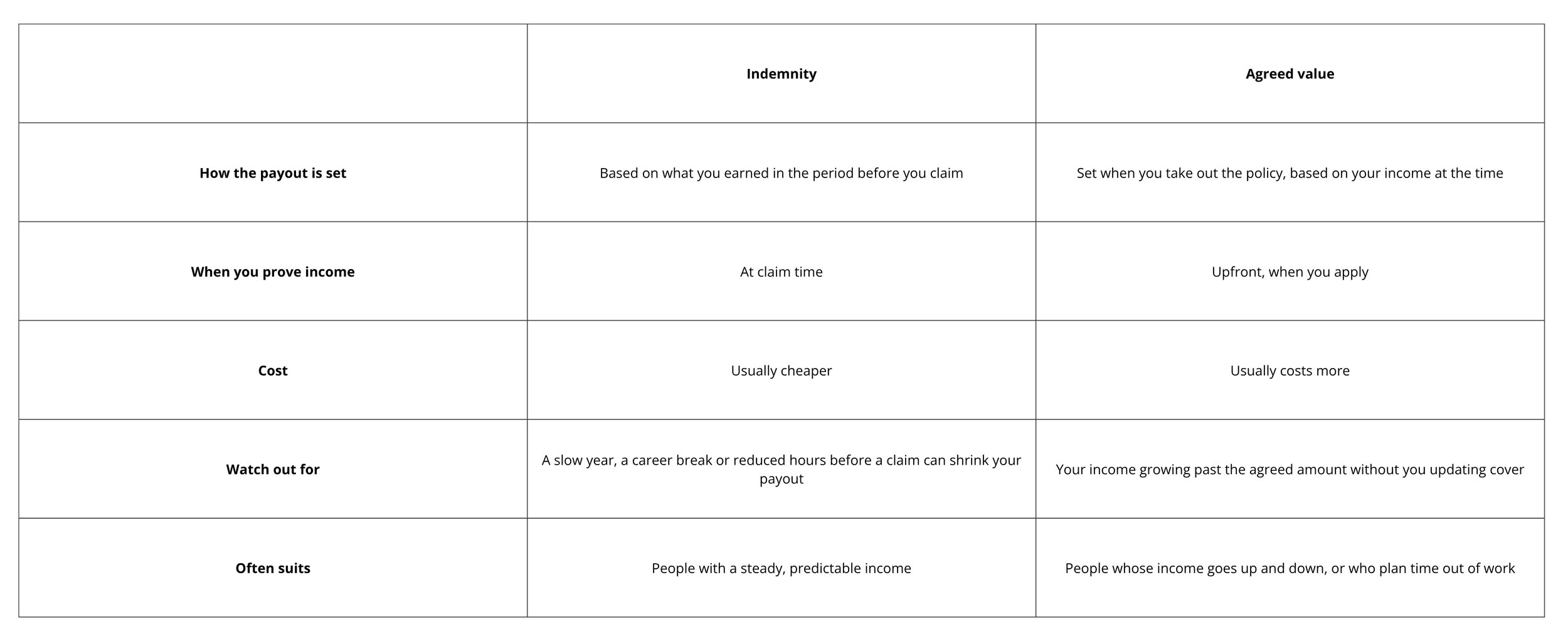
If you've had a quiet patch, cut back your hours or taken time off for family, an indemnity policy may pay less than you'd planned on. Agreed value gives you certainty, but you'll need to show your income when you apply.
Insurers define these terms differently, which is why comparing the policy wording matters more than comparing the price.
Wait periods and benefit periods, explained
Two settings shape your cover and what you pay for it.
The wait period is how long you need to be off work before payments start. Common options range from a few weeks to a year. The longer the wait, the lower the premium, so the question to ask is how long you could cover your bills from savings or business cash flow. If the answer is about two months, there's little point paying for a four-week wait.
The benefit period is how long the policy keeps paying once a claim starts. That might be two years, five years, or through to age 65. Shorter periods cost less, and a short illness is often manageable from savings. The serious, long-term ones are what can sink a household, so the benefit period is worth thinking through carefully.
Pregnancy, parental leave and your cover
This is where generic advice falls short, and where planning ahead makes the biggest difference.
Apply before you're pregnant, if you can. If you apply for income protection while pregnant, some insurers may exclude pregnancy-related conditions or postpone cover until after the birth. Sorting it early gives you the widest choice.
Check how your policy treats time out of work. Income protection is tied to your income. If you take parental leave, reduce your hours or pause the business, that can affect what you'd receive if you needed to claim later, especially on an indemnity policy that looks back at recent earnings.
Ask about parental leave options. Some policies let you pause premiums or keep cover in place while you're on parental leave. Others don't. The details vary from insurer to insurer and policy to policy.
Review your cover when you go back to work. Your income, hours and financial commitments have probably changed. Your cover should keep up.
If a baby is on the cards, a cover review before you start trying is one of the most useful money conversations you can have.
What affects the price
There's no single price for income protection. Your premium depends on:
Your age and health, including whether you smoke
Your occupation, since some jobs carry more risk than others
How much cover you take, as a share of your income
Your wait period, where a longer wait means a lower premium
Your benefit period, where a shorter period means a lower premium
Indemnity or agreed value, with agreed value usually costing more
Optional extras, which some policies offer at an added cost
The cheapest policy isn't always the best value. A policy that costs less but pays less, or doesn't fit how you work, is an expensive way to save money.
Why talk to an adviser?
You can buy income protection directly from an insurer. But you'll only see that insurer's policies, written in that insurer's words.
As advisers, we compare cover across multiple insurers and read the policy wording for you. We'll ask how your income works, what your plans are and what you could manage without, then talk you through the options in plain English. If you already have cover, we'll tell you if it's working for you. We won't suggest changing a policy without a good reason.
We work with women and self-employed people right across New Zealand, by phone or Zoom, at times that suit your week x
-
Yes. Self-employed people can get income protection. You'll usually need to show your income, for example through tax returns or financial statements. goes here
-
No. ACC covers injuries from accidents. Illness isn't covered, which is why income protection matters for people without sick leave.
-
Indemnity pays based on your income before you claim. Agreed value pays based on income you prove when you take out the policy. Agreed value often suits people whose income varies.
-
Often yes, but some insurers may exclude pregnancy-related conditions or delay cover. Applying before pregnancy usually gives you more options.
-
It can. Because cover is linked to income, time out of work may affect a future claim. Some policies have parental leave options. Check your policy or talk to an adviser.
-
It depends on your age, health, occupation, how much cover you take, your wait and benefit periods, and the policy type.
The information in this article is general in nature and isn't personalised financial advice. Talk to an adviser about your own situation before making any decisions about your insurance. A disclosure statement is available on request.
